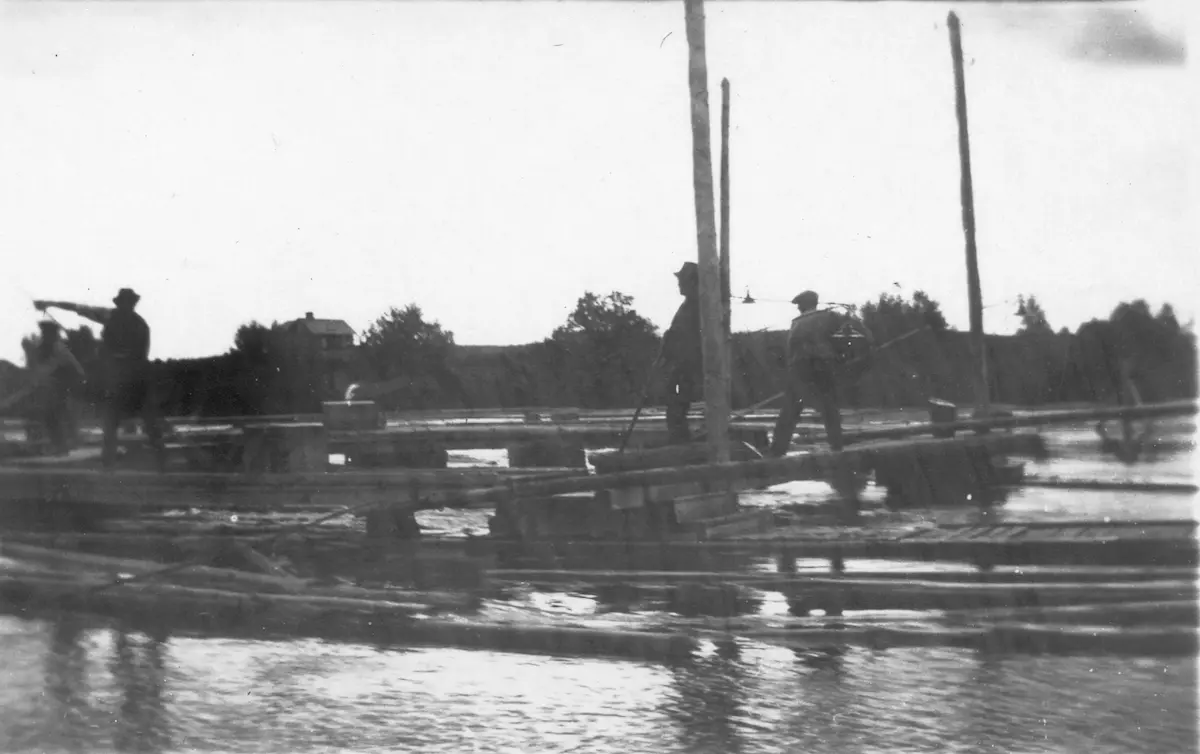
Today, the Dal River is associated by many with fishing, birdlife and a quieter landscape. But for much of the 20th century, the river was also a central transport route for the forestry industry. Enormous quantities of timber were carried through the waterways on their way to sawmills, pulp mills and other industries further downstream.
A carpet of timber
Every spring, when the ice broke and the meltwater came, log driving began in earnest. Logs that had been felled during the winter were hauled to the water's edge and then followed the current down the river. During the most intensive years, over 20 million logs a year were transported on the Dal River.
At the Tägten sorting works, timber from different forest owners was separated. There, the river could at times be covered by such vast quantities of logs that it looked almost like a continuous surface of wood. Log driving required both extensive infrastructure and great skill to function.
The log drivers' work
Work on the river was heavy and dangerous. The log drivers guided the timber through rapids, past shallows and bridges and worked to break up jams where logs had got stuck. The work was seasonal but intense and during the busiest weeks it demanded both endurance and deep familiarity with the water.
The Dal River was one of the country's great log-driving routes and major forest owners like Stora Kopparberg were key players in the system. Log driving was a vital link between the forests of the interior and the industry further down the river system and along the coast.
The end of an era
In 1970, log driving on the Dal River came to an end. By then, lorries and other road transport had gradually taken over an ever-larger share of timber haulage. The river lost its role as a timber transport route, although it had already been shaped by other interventions, including dams, log-driving installations and hydropower development.
Along the banks, traces of the log-driving era can still be found: old guide booms, sorting works and other remains that recall a time when much of the forest's journey to industry went through the water.