Why cannons in Falun?
G2A (or Gustavus Adolphus, as he is better known) had quite a lot of warfare on his hands in this period. That meant a great many cannons were needed and copper was one of the main ingredients in the so-called copper cannons.
Despite the name they were not made of pure copper but of a copper alloy. According to Lyberg the mix was raw copper and garcopper, that is refined copper, with just under ten per cent brass and tin added. The result was a kind of gun bronze that at the time was considered superior to iron in several respects, even if it was also considerably more expensive.
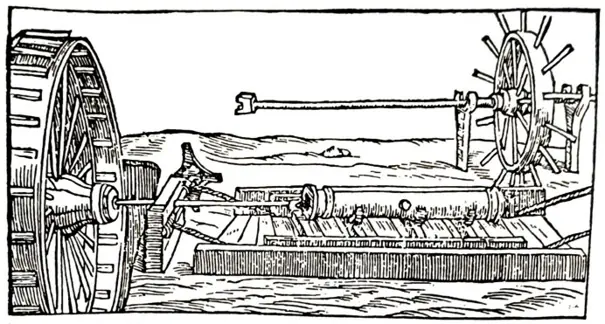
So when the king needed a new gun foundry, the cannon factory of its day, the choice fell on the Crown's smelting houses at Östanfors. There were smelting houses the Crown no longer used for its own purposes, water power to drive the machinery and the raw material close by.
Where exactly were they?
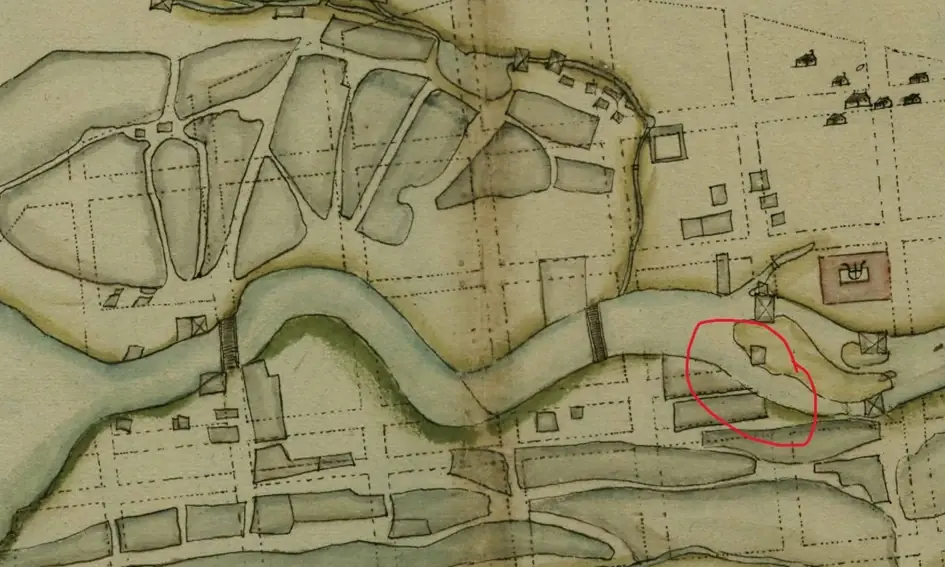
This is the exciting part, because we can actually get fairly close. Lyberg writes that the Svärdsjö smelting house, where the boring house stood, lay just above the bridge on the line of today's Södra Mariegatan. That is today's Hanrö bridge, once called Urlakningsbron. The other three smelting houses, Lyberg thinks, were probably in roughly the same place.
Samuel Frigelius's map from 1688 also marks the "Borhuset" (boring house) at the eastern end of the bridge. Axel Östberg places it where Södra Mariegatan crosses Slaggatan.
So somewhere around the bridge and along today's cycle path is where the foundry should have been, if I read the maps correctly. But the Falu river looked different in the 17th century and large parts of its banks have since been filled in with slag. Exactly where the various buildings stood is therefore hard to say.
Peter Cahun? Not the best known, perhaps
To begin with, the name Cahun is said to be a Swedish rendering of the Scottish name Colquhoun. According to an old family tradition he was the grandson of a Scottish baronet, had served as gentleman of the bedchamber to Duke Charles and then lived as a refugee in Poland before ending up here.
It sounds exciting, but how much of it is true is another matter. Lyberg himself doubts it and suspects, among other things, that the court service and the exile may have belonged to another member of the family. Hildebrand settles for noting that Cahun was of Scottish descent.
What we know with much more certainty is that he was a merchant. As early as 1613 he turns up in the Stockholm weighing house ledger, weighing in copper. He married Kristina Hansdotter Svahn, daughter of a Stockholm alderman. Later he moved to Falun and became a trader at Slaggen, a mine owner and in 1628 one of Falun's aldermen.
During the 1620s he was the Copper Company's buyer at the mine, the middleman between the company and the mine owners. The problem was that he was doing copper deals of his own at the same time. The mine owners were not keen on that arrangement and complained to the government. In 1627 he had to give up the post, on the express orders of Gustavus Adolphus.
At around the same time Cahun also wrote a long account of conditions at the Kopparberg mine between 1600 and 1630. And here we actually get a rather entertaining picture of the man.
He dismisses the monopolies as "intolerable monopolia, such as are forbidden in Roman law", criticises how the mine is run and is fond of proverbs. Whoever knows how things really stand must still "howl with the other wolves". And the merchants were drawn to Kopparberg as "the eagle gladly seeks where the carrion is".
At the very least you get the impression of a man who was not afraid to speak his mind.
The contract
Here the story takes a turn. Only three years after G2A had Cahun dismissed as copper buyer on his express orders, Cahun is instead given the job of setting up a gun foundry.
In the spring of 1630 a couple of agreements were first made between Cahun and the Crown's representative David Fredrik von Siegroth. A little later that year, on 28 May, Gustavus Adolphus himself signed the main contract in Stockholm.
Siegroth was not just anybody either. He had attended the court school in Kassel, his father was an artillery expert and he himself was counted among the leading cannon experts of his day.
He is usually credited as the originator of the light regimental guns. These were small, mobile cannons that could follow the infantry on the battlefield, above all three-pounders firing balls of about 1.3 kilos. According to Lyberg it was precisely these regimental guns that made Swedish artillery so successful in the Thirty Years' War.
The division of labour was clear. Siegroth would handle the design and Cahun would do the casting.
What did it pay?
Quite well, actually. More than quite well.
To begin with, Cahun was allowed to use four of the Crown's smelting houses rent free for six years. The contract names them as:
- Gamble hyttan
- Smedjehyttan
- Svärdsjöhyttan
- Mårten Wewitzers hytta
There was a catch, of course: Cahun had to pay for the rebuilding himself and fit the smelting houses with bellows, boring mills and turning mills among other things.
He was also allowed to lease the Crown's tax revenues in Kopparbergslagen and Österdalarna on the same terms as the merchant Petter Grönberg had held them before him. The tax revenues were part of the payment for the cannons, but Cahun also got a special privilege: he could use the charcoal and wood covered by the lease for his own business. A rather valuable asset when you are running a large cannon foundry.
And it did not stop there.
He was also given the use of the Crown's horse paddock Herrhagen and two small farms by the mine, Dikarbacken and Gamla gården, for a low rent. On top of that he could work five pairs of the Crown's mine shares for the usual fee, to secure the supply of copper for the cannons.
The following year, 1631, he was also granted the farm Hushagen in Stora Tuna as a fief and in 1632 the lease on the Crown's revenues in the counties of Västerås and Strömsholm.
According to Lyberg all these privileges made him "the most prominent man in the Falun community, the governor excepted".
And the cannons?
They got going fairly promptly. Only a couple of months after the agreement the casting had begun. In August 1630 the first deliveries were sent off and in the course of that year 76 cannons were delivered in all, 36 of them "three-pound regimental guns".
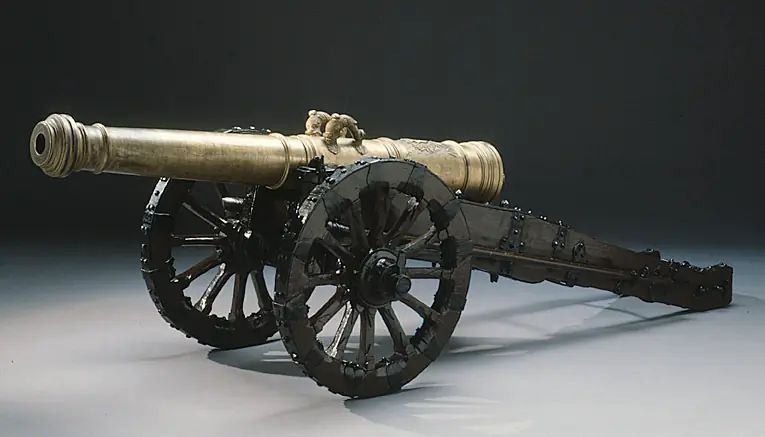
Then came the problems. When the three-pounders were test-fired in Stockholm, 14 of them burst. The following year 108 cannons were sent, mostly twelve- and six-pounders. This time it was the six-pounders that were wrong. They were so badly balanced that they tipped over when placed on their carriages.
So whose fault was it? Siegroth had to write a report on what had gone wrong. Cahun was told the guns should be made differently and replied that he had not had any "commando" over the dimensions.
Lyberg suggests that if that objection was accepted, it was because the fault probably lay with the inspector Siegroth and his assistants rather than with Cahun.
Either way, Cahun did not have to pay anything, even if he did not make the profit he had counted on. Many of the cannons could be melted down, so the metal could be reused.
After these misses things started to happen.
In 1632 and 1633, 195 cannons were sent off. Among them were 51 demi-cannons, 24-pounders weighing around ten ship pounds apiece (just over a tonne). In total almost 400 cannons were sent to Stockholm under this contract.
Since he was paid by weight, thirty-five riksdaler per ship pound, 1632 alone came to more than 89,000 daler.
How does it end?
In April 1633 it stops. The Crown's accounts record no more weighings of these cannons. When they resume in July, the entry reads "the late Peter Cahun's heirs". So he died during the spring. A record from the Svea Court of Appeal a few years later says he "oförmodeligen blef dödh", that is, died unexpectedly. What he actually died of I have not been able to find.
The foundry was taken over by Johan Trotzig, the son of Cahun's wife's sister. Under him it became the largest gun foundry in the realm and it actually kept going until the early 1650s. But that may be another article.
Cahun's sons shortened the name to Caun and before long it became Gahn. So Peter Cahun is the founder of the Gahn family. Its best-known member is of course Johan Gottlieb Gahn (more on him later).
Any traces today?
So is anything left? Any cannons? According to Hildebrand in 1946 there are no cannons that can be directly linked to Falun. But I have found a list of what was salvaged from the wreck of the royal ship Kronan in 1683 and 1684.
It includes four twelve-pounders called "Kopparbergsstycken", Kopparberg guns. Probably cannons from Falun. What happened to them after that I have no idea. But they were there, or probably were, aboard Kronan when she sank in 1676.
A closing thought: how many cannons from Falun were at Lützen on 6 November 1632?
Sources
- Ernst Lyberg, Borns hyttegård samt styckegjutarna i Falun, 1944, pp. 11, 14, 125–145, 152–153, 159, 171–179
- Ernst Lyberg, Falu stad och borgare före 1641, 1940, pp. 57–58
- Karl-Gustaf Hildebrand, Falu stads historia till år 1687, 1946, pp. 355–357 (incl. caption), 401, 769
- Axel Östberg, Det gamla Falun i ord och bild, 1978, pp. 175, 193–196
- Nils Sahlström in Staden vid Falan vol. 1, 1925, p. 40
- Sten Lindroth, Gruvbrytning och kopparhantering vid Stora Kopparberget vol. 2, 1955, p. 93
- Daniels Sven Olsson in Elizabet Ståhl (ed.), 111 betydande män och kvinnor i världsarvet Falun under 400 år, 2012, pp. 30–31
- Jan Glete, Kronans artilleri, working paper 2002
- Svenskt biografiskt lexikon, "David Friederich von Siegroth", via Riksarkivet
- Svea Court of Appeal, records 1636–1638, SE/RA/420422/01/A II a/2, image 54