The first time Åsen appears in written sources is 1540. The subject is not town planning or mining but violence. The maid's farmhand of a woman named Karin was fined for striking another farmhand in the head with an axe. We do not know how the victim fared, but the fine was low enough to suggest he survived.
It was in this part of Falun, on "the pleasant side" of the river, that Arkeologikonsult carried out their largest excavation in Falun to date. In two campaigns, 2019 and 2023, just over 4,300 square metres of the old Posten car park were dug, behind the headmaster's residence that now houses Falu Bröd (Hammars). The report ran to 571 pages. Eight thousand cubic metres of soil and slag were moved. Roughly six thousand finds were documented.
Rubbish before town
Perhaps the most surprising result was that nobody seems to have lived on the site before the 1600s. The only medieval find was two small pieces of window glass, dated to the late 1200s or 1300s. In the medieval period, glass windows were found mainly in churches but also in occasional secular high-status settings. No such setting is known from Falun at that time. The glass was also found in a redeposited layer, so it cannot be securely linked to the Posten quarter and may have arrived with fill from another location.
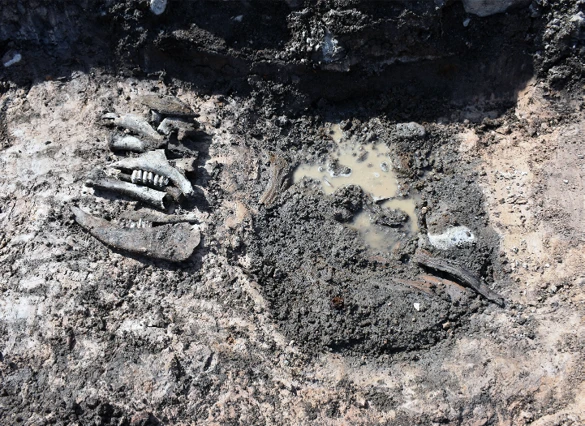
What people did do in the early 1600s was use the site as a rubbish dump. The topsoil appears to have been stripped first, possibly because it was needed for cultivation. Then large quantities of waste were tipped out. The butchery remains show that animals, mainly cattle, were brought alive to town and slaughtered on the spot. The link to the mine is close: oxen that had served out their time as draught animals underground ended up in the pot. It is the familiar Falun sausage story, told from the other end.
The waste layers still smelled when the archaeologists dug them, four hundred years later.
The cauldron and the lock
At the bottom of the waste layers lay one of the more unusual finds: a three-legged copper cauldron with forged iron legs. A footed pan, completely worn out and repaired. The original legs had fallen off and new ones had been riveted on next to the stumps. The cauldron was so fragile it was lifted from its resting place only once, for a photograph, before being put back.
Most copper vessels preserved in Sweden date from the 1700s or later. This one is securely dated to the 1600s. The three-legged, round-bellied form barely changed over several centuries, but its position in the stratigraphy makes the dating certain. Next to the cauldron lay a barrel padlock, an old type of padlock that fell apart on recovery but revealed its mechanism in the process.
One might expect copper objects to be common in Falun of all places, but reality was different. The state held that Falun should produce raw copper, not refine it further. A coppersmiths' guild charter was not granted until 1781, very late compared to other Swedish towns.
Houses built with old techniques
Settlement was established on top of the waste. It is a pattern familiar from virtually every older Swedish town. People did not cart away their rubbish; they built on top of it. Half of Stockholm rests on the same principle.
The archaeologists found traces of a lane with houses on both sides, oriented in a direction that deviates from the present street grid. This may represent an older street pattern, from the time before regulated town planning took hold.
One of the houses was built using a technique that normally belongs to the medieval period. One of its posts could be dated by dendrochronology to 1611–1612. Heavy posts had been sunk into the ground and logs fitted into slots cut between them. The archaeologist had searched for parallels without finding anything similar from the 1600s outside Falun. Sigtuna and Skara have comparable structures, but they are medieval. The building is interpreted as a brewhouse or cookhouse. The hearth occupied a quarter of the floor area.
When the posts were worked free from the blue clay, several turned out to have swastika marks cut into them. In the 1600s the symbol did not carry the burden it bears today. It may have been a protective mark, carved to guard the building, similar to those at the entrance to Ornässtugan. But the marks were below ground level, where no one could see them. They may also be timber marks, cut to identify who had supplied the wood and ensure payment.
The fire that left no trace
The town fires of summer 1761 burned a combined area of over 260,000 square metres of Falun in ten days. But in the Posten quarter, hardly any fire traces were found. Only an area of roughly one by three metres contained charred grain. Otherwise, people had cleaned up thoroughly. Timber that had not burned through entirely may have been reused. What was charred was good enough for fuel in the mine.
Building began immediately after the fire. A log foundation of trees felled in the winter of 1761–62 was found outside the small toilet building down on the car park. The house raised on that foundation stood until at least 1909.
Finer folk on Åsen
The ceramics and glass that emerged showed that Falun was one of Sweden's most internationally connected towns during the 1600s and 1700s. About 18 per cent of the ceramics were imported, a normal figure for the period. But in the 1700s layers, the proportion of porcelain was unusually high. It is the clearest sign that the people who lived here could afford it.
The written sources confirm the picture. In the early 1600s, 35 households lived on Åsen, mostly tailors, painters and carpenters. By the middle of the century the number had grown to 127, with innkeepers, glaziers and people of foreign origin. During the second half of the 1600s, mayors, mine masters and aldermen moved in. The member of parliament Fredric Muncktell, with his Chinese export porcelain service, lived here until the fire. Muncktell was one of the leading burghers in town and moved in the same circles as Johan Alströmer and Carl Hårleman. His probate inventory from 1763 lists, among other things, a blue and white Chinese export service with seven dozen plates, twelve dishes and two tureens, as well as porcelain from Rörstrand.
One of the more interesting macrofossil analyses showed that people ate berries in quantity: cherries, damsons, apples, raspberries, lingonberries. They grew hemp or hops, baked with rye and oats, and brewed beer from malted barley. Someone had eaten raisins.
What remained
The site has changed dramatically. Åsen is largely built up. The original ground level shows only half a metre of height difference where today the slope is considerably steeper. Layer upon layer of waste, fire debris and slag have shaped the topography we see today. The headmaster's residence, built in the 1760s, probably rests directly on top of the levelled fire remains.
The best houses most likely remain beneath the headmaster's residence, along Åsgatan, where people always built with the façade facing the street. What was excavated were backyards, brewhouses and gardens. Cultivation went on there in every period, right up to the mid-1900s. An aerial photograph from 1951 still shows rows of bushes and trees on the plot.
Then came the police station, the petrol station and the car park. Most of the 1800s layers disappeared. But beneath the asphalt and slag, the 1600s and 1700s remained, with waste and building remains that tell the story of a neighbourhood that grew up on its own rubbish.
This article is based on a lecture by Åsa Berger, Arkeologikonsult and the excavation report (2025:3070/3625). The full report is available on Arkeologikonsult's website.