In January 1722, the bookkeeper Erik Brandberg entered a note in the storehouse's journal. To the monthly-paid workers, 5,333 daler kopparmynt and 8 öre had been paid out. The sum matched what the foremen had recorded on their lists of each worker's claim. The payment, however, was not made in coin. It was made in goods. Rye, barley, salt, pork and woollen cloth were collected over the counter against the worker's account. Of a monthly wage of 25 daler, perhaps 3 or 4 could be drawn in cash. The rest went to food and clothing.
This, not the merchandise shop, not the silks, was the actual function of the Mining Company's storehouse. It was the workplace's pay office. And it was far more than a shop.
Wages in goods
The system was called the storehouse obligation. The miners received their wages in the form of a claim (a credit balance) on the storehouse, and that claim was redeemed in goods. For the Mining Company, the advantage was practical: it avoided handling cash in a time when coin was often scarce, and it could control what the workers bought and at what price. For the worker, the picture was mixed. On the plus side: by decision of the mining court, prices at the storehouse were lower than at the burghers' shops, and goods were always available, even when the market square stood empty. On the minus side: one was bound. The free choice to shop where it was cheapest, as mining master Lybecker had defended already in 1701, was gone.
The storehouse obligation for the mine-shift workers was formally abolished in 1725, after the royal commission's audit. But in practice, most of it continued. Of a miner's annual wage of 370 daler kopparmynt, still barely a quarter could be drawn in cash. The rest was taken out in goods over time, month by month, on account. To shop anywhere else required cash one did not have.
Subsidies and written-off debts
The other thing that made the storehouse a social institution rather than a commercial enterprise was the pricing in times of crisis. The Mining Company charged no interest on the workers' debts. And during years of failed harvest, prices could be lowered below cost.
In the winter of 1757, in the middle of the severe famine years, the mining court decided that the price of barley should be set at 40 daler per barrel, this to accustom the workers to mixing barley into the bread during the dearth. The rye price stood then at 50–54 daler. In June of the same year, the king donated 300 sacks of rye flour, to be given first of all to the poor and sick workers. When the Mining College's commission of 1764 visited Falun, it found that the storehouse's own purchase prices were now too high for the workers to be able to pay, and that the Mining Company in the current dearth should not aim for any profit. Better to sell at a loss than to accustom the workers to high money wages. An interesting way of handling inflation.
To this came the written-off debts. Workers who could not pay had their debts struck from the accounts. In 1764, the storehouse's outstanding claims against people of rank, mining men and miners amounted to nearly 102,000 daler kopparmynt. Part of this was never recovered. It was written off.
Boëthius, who first made a thorough investigation of the storehouse's operations, has called this "a kind of partial index-linking" of wages. Subsidized prices, interest-free credit, written-off debts. That is the vocabulary of a later age, but the description points to something real.
What disappeared with the fire
When the storehouse yard burned in 1761, the buildings were destroyed but the documents were saved. The storehouse was rebuilt on the same plot and continued its operation in the new stone building from 1766. But the function thinned out. The merchandise trade had already been phased out. The grain trade became a smaller and smaller part of the Mining Company's activities as wages came to be paid in money and the town's burghers took over more of the trade.
The house on Åsgatan became a headquarters.
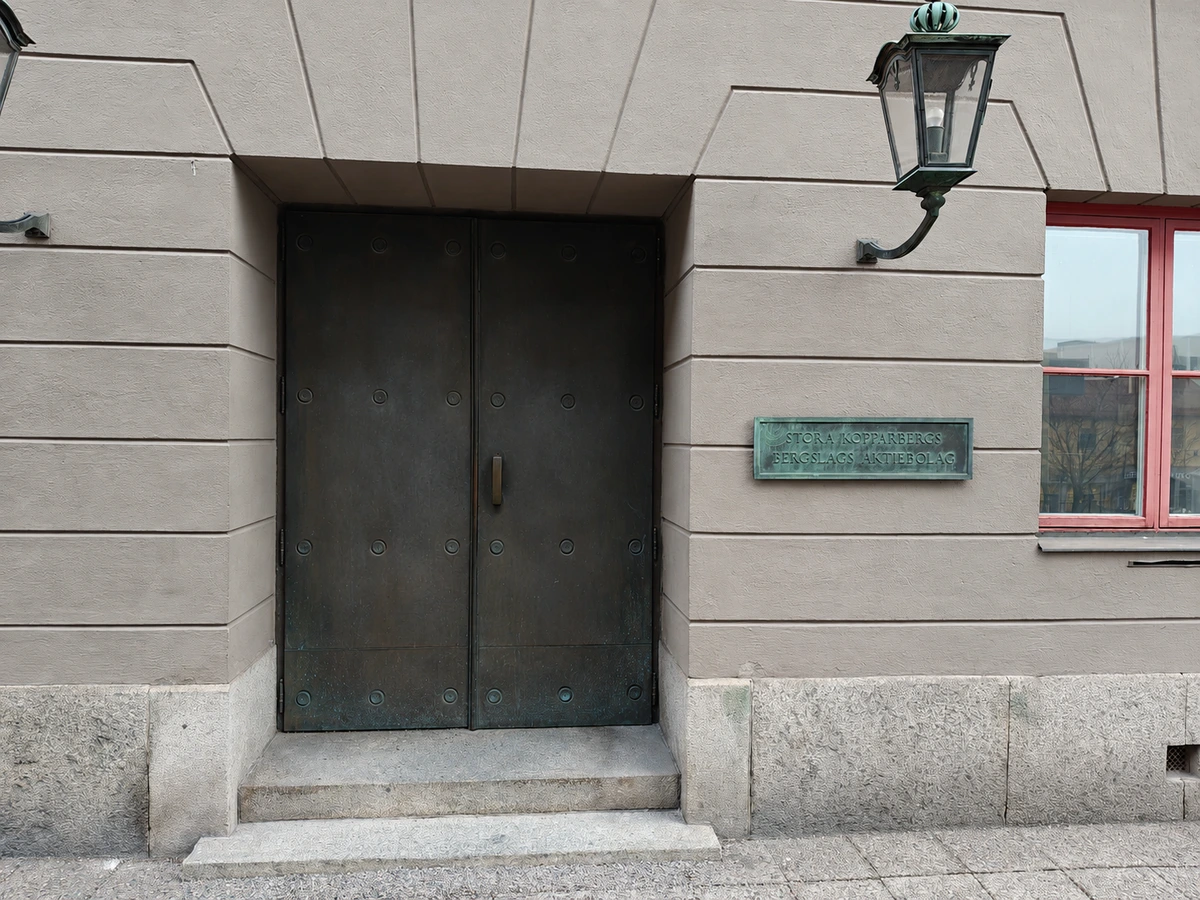
But in the underground vaults, in the upper floors' grain lofts, in the copper door that still hangs in place, everywhere there are traces of a building that for a century and a half not only administered the Copper Mountain but also constituted the very supply apparatus for those who worked there.