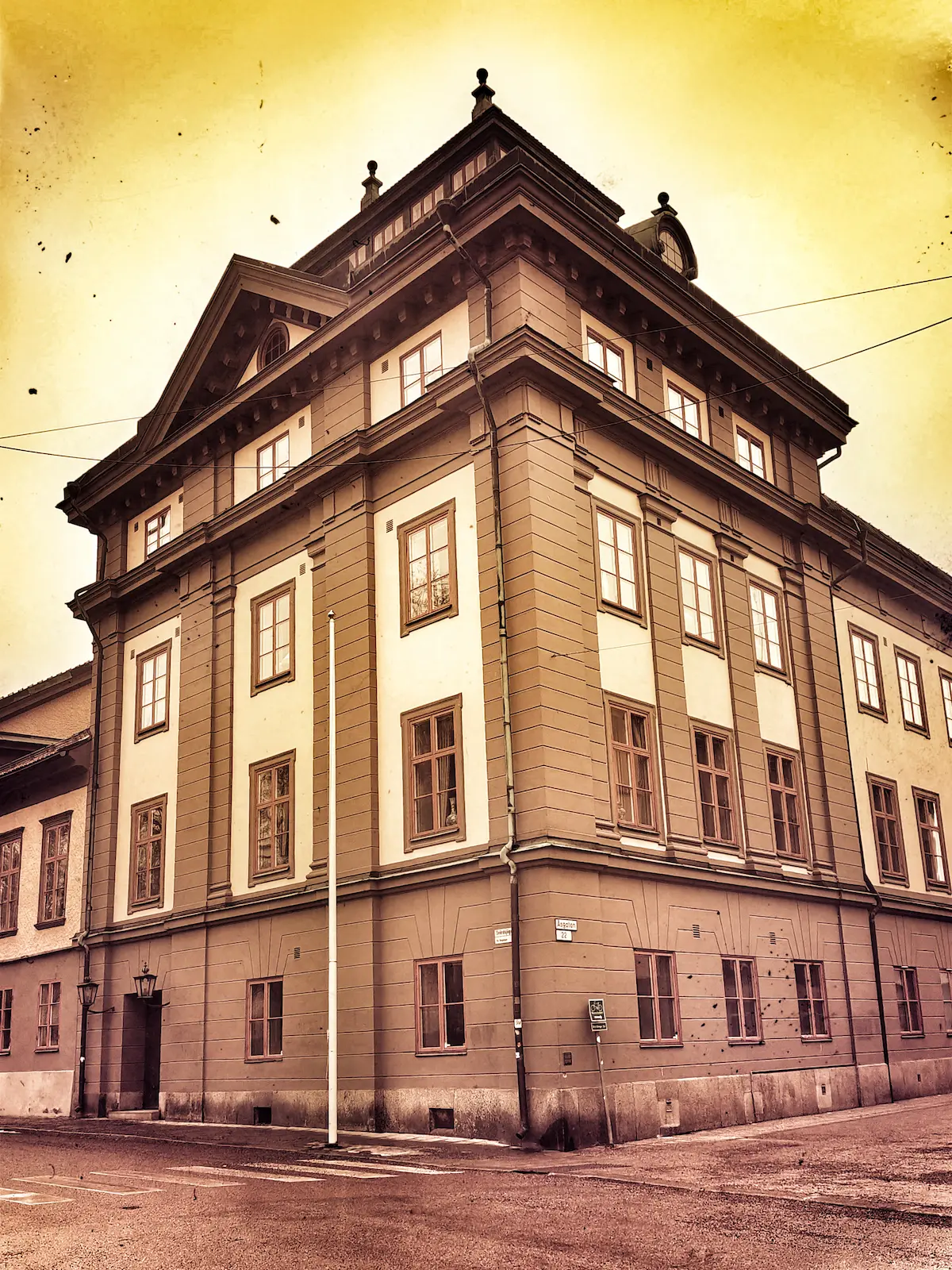
After the town fire in the summer of 1761, the storehouse yard on Åsgatan lay in ruins. All buildings except the granaries had been destroyed. But the documents had been saved. Rebuilding began immediately.
A new building in stone
The yard was expanded when the Mining Company purchased part of the neighboring plot to the south. In 1766, a new office building was completed. This time it was built in brick, two stories tall, with large grain lofts above. From the street, two carriage entrances led into the yard. Through doors opening directly onto Åsgatan, one reached the commercial premises on the ground floor. Inside were eleven vaulted shops and offices, plus five other rooms. On the upper floor there were meeting rooms, living quarters and a couple of offices. The building ended then, as now, with short wings.
At the end of the 1780s, the administration was reorganized. A formal headquarters was established in the building. Mining master Clas Wallman, who in addition to being a skilled mining man was a talented architect, drew up plans for a renovation in 1806. The upper floor received the beautiful design that was largely preserved into the 20th century. Traces of Wallman's interior remain in what later became the managing director's room, with pillar tile stoves and a long enfilade of rooms with double doors.
The Bergslag Ballroom
In 1817, it was decided to extend the northern wing and create a ballroom. This commission also went to Clas Wallman. Falun lacked venues for larger events, so the hall quickly became the town's gathering place for concerts, balls and official dinners. The first royal guests were Charles XIV John and Crown Prince Oscar, who visited Falun on September 13, 1819. The town arranged a dinner for 150 guests in the new hall in their honor.
The ballroom's interior was in the restrained elegant Empire style typical of the copper mining estates during this period. Along the long sides ran double rows of benches in amphitheatrical arrangement. From the ceiling hung Empire chandeliers in three rows.
In 1857, the ballroom underwent a restoration that was not entirely gentle: the original herms (pillars with heads) supporting the gallery balustrades were replaced with consoles in 1850s Rococo. The Empire chandeliers were exchanged for heavy crystal chandeliers from Germany.
A third story and a new facade
Toward the end of the 19th century, the Mining Company's operations grew. The office space became too cramped. In 1904–05, a third story was added, designed by architect Klas Boman in Falun. In connection with this, the entire facade was changed. Previously, the building had resembled the 18th-century buildings that still stand on the opposite side of Åsgatan. Now the three-story building received a Renaissance-inspired exterior, with the Swedish East India Company building in Gothenburg among its models. It is the facade you see today.
The copper door
Next time you walk past on Åsgatan, pause for a moment at the entrance. The copper door is still there. It is one of the most tangible links back to the time when copper was not merely a commodity but the very foundation of the town's and the Mining Company's existence. Not a museum piece behind glass, but still in its place in the building that for over 250 years has been the center of one of Sweden's oldest companies.