Walking along Åsgatan in central Falun, sooner or later you will pass a large yellow-plastered building on the corner of Svärdsjögatan. It is the old headquarters of Stora Kopparberg Mining Company. But the building you see today is not the first on this site. Nor the second. The history of this plot stretches back to 1646. It has seen fires, rebuildings and changes of purpose that mirror the entire development of the Falun mine and the town itself.
A mining master's ancestral estate
The plot on the corner of Åsgatan and what was then called Torggränden was owned in the 1640s by crown tax inspector Anund Jöransson. Through his successor Anton Svab, it eventually passed to his son Anders Svab, mining master at the Copper Mountain and one of the most important figures in the Mining Company's early history.
Anders Svab was not only an industrial organizer. He took on the social problems of the Copper Mountain and the town. The miners needed a place where they could collect their wages in the form of provisions. The mining men had long searched for suitable premises. Svab offered his ancestral estate. The Mining Company accepted, started the storehouse operation in 1716 and purchased the property shortly thereafter.
The storehouse yard takes shape
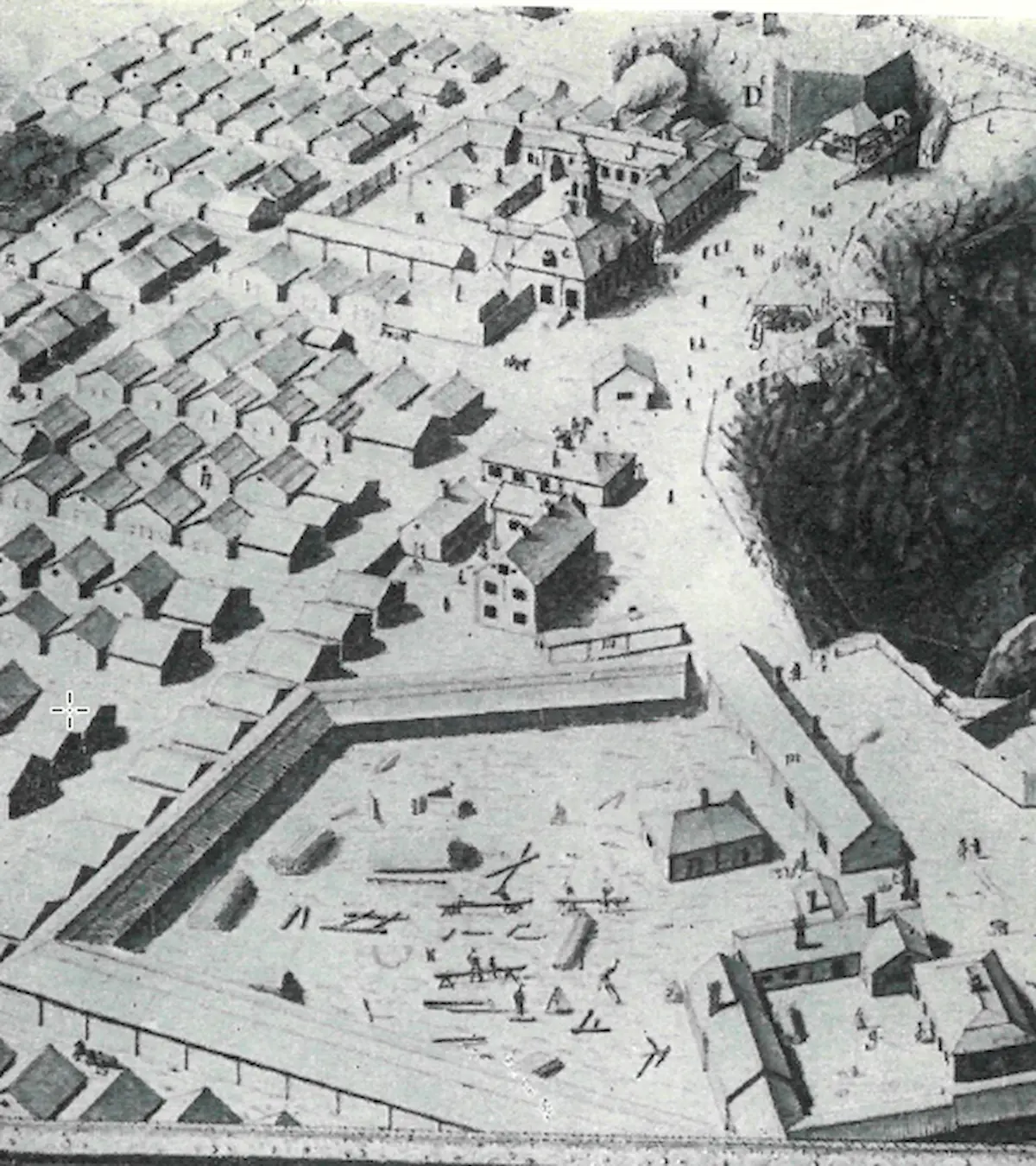
The estate was transformed into a small community of its own. On the plot stood the red-painted main building with whitewashed walls and blue-painted ceilings in every room. A carriage entrance from Åsgatan at the market corner led inside. Along Svärdsjögatan lay an old hall building with twelve windows, likely used for festivities by the Jöransson and Svab families. In the backyard there were stables, a cow barn and a hen house. On Trotzgatan stood a granary.
With the storehouse institution in place, new buildings followed quickly. On Åsgatan, a provisions store was built with grain lofts on the upper floor, along with a general merchandise warehouse. On Svärdsjögatan, an assay chamber was established. It was there that Carl Linnaeus gave lectures during one of his visits to the Copper Mountain. On Trotzgatan, grain warehouses and stores were added. The entire complex resembled a large-scale trading yard.
Eventually an office building was also needed, erected along Åsgatan. It was a red-painted timber house of two stories with a large hall on the ground floor and, on the upper floor, the regimental hall among other rooms, where the Mining Regiment (Stora Kopparberg's own regiment, established in 1656) held its court martial.
The fire
On the night between June 30 and July 1, 1761, fire broke out near Yxhammarstorget, on the western side of the Falun River. The fire spread down what is now Stigaregatan, took the Copper Scales and Falun Bridge with it and continued eastward. The firewood office yard and the storehouse yard on Åsgatan were destroyed. All buildings except the granaries were lost.
But the documents and accounts were saved. The provisions and merchandise survived as well. And rebuilding began at once.
Read part 2: How the new stone building was erected, how the Bergslag Ballroom came to be – and why the copper door still hangs at the entrance.