I did not expect to go digging into this subject. But I have had a few questions about it and realise it deserves some proper reading.
How were the horses used?
You might assume the horses were simply a means of transport. They were used for that on a large scale, of course. But this article is about the horses that were literally in the mine. Down in the mine.
The horse whim complemented water power
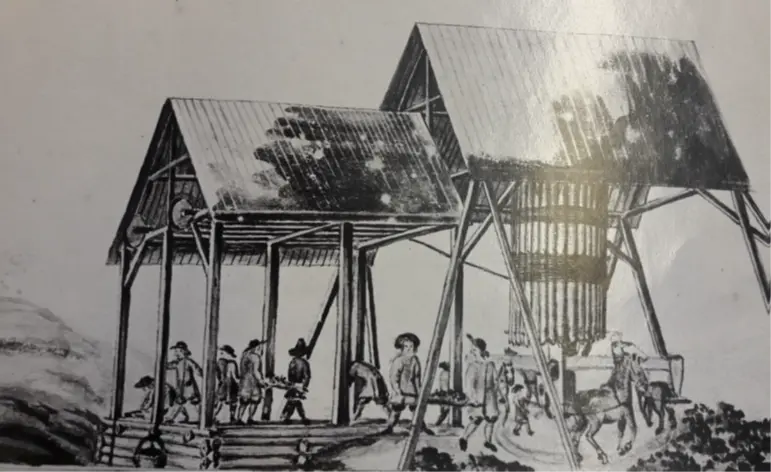
The first horse whims came to Falun in 1545 or 1546. The construction is fairly simple. The horses walk in a circle around a vertical shaft, called the heart post, which in turn connects to some form of power transmission. In the mine it was mostly a matter of hoisting things up and down the shafts: ore, waste rock, earth and of course people. The whims could also drive pumps to keep the groundwater at bay.
It took large numbers of horses, or perhaps rather horsepower. In 1579, 430 animals were at work at the mine. It was the peasantry and the master miners who had to supply them. By 1587 only 165 horses remained on the books. Why the number fell so sharply is not fully understood. In the 1670s somewhere between 17 and 19 horse whims were in operation above ground.
The horses quite literally did a horse's work. During that period the whims raised around 200 barrels of material a day and each barrel held about 136 kg of ore. That comes to roughly 27 tonnes a day.
Underground
Over the years the mine grew deeper and the shafts more complicated. The hand whims used down in the mine, the human-powered equivalent, were no longer enough. In 1695 the mining councillor Harald Lybecker began building the first horse whim underground. It was finished in 1697 in the chamber called Bandknippan and he lent four of his own horses to drive it.
After that the underground horse whims grew steadily in number. They were smaller than the whims above ground, which could have up to four horses. Underground they were usually driven by one or two. In 1744 there are said to have been 17 horses underground and in 1783 there were 23 at the same time.
How did they get down into the mine?
Horses are not known for their climbing, so they needed some help. They were lowered down the shafts, hanging in a purpose-built harness. The French priest Réginald Outhier described it like this:
When horses are to be taken down the shafts, this is done by fastening them to the cable trough with a harness that encloses their whole body, and then lowering them down.
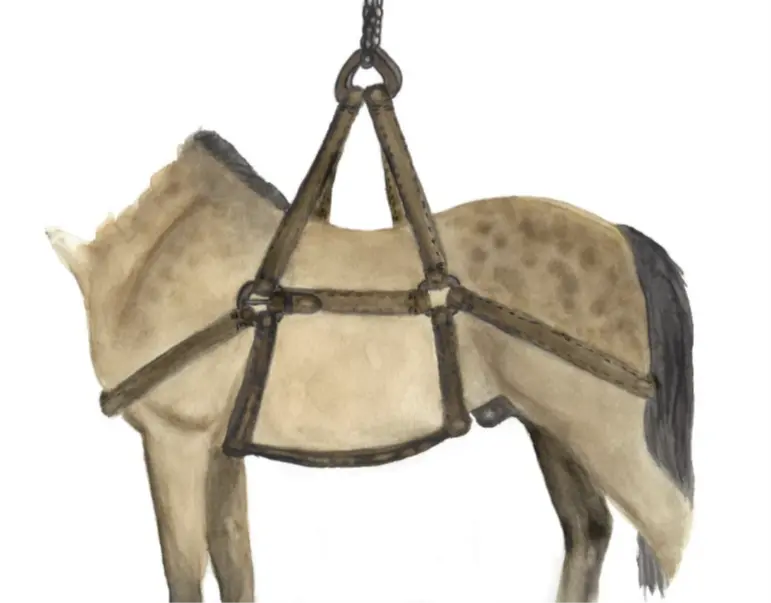
Parts of such a harness survive and the Sala silver mine has a better preserved one. What is interesting about them is the measurements. From them you can work out that the horses were small, very small: 125 to 135 cm at the withers and, at a guess, somewhere between 270 and 350 kg. So these were no big draught horses working down in the mine. They were closer to ponies.
The horses were probably also blindfolded to keep them calmer on the way down.
Stables underground
Lowering the horses every morning and raising them again every evening was both time-consuming and hard on the animals. So in the 1720s stables began to be built down in the mine.
Carl Linnaeus visited the mine in 1734 and writes that there were stables, hay and a forge down there. In 1782 there were stables in six different places, with two or three stalls in each.
That many horses underground also needed feeding and watering. In total it took just over 50 kg of hay and 1000 litres of water a day. The manure had to be dealt with too. The responsibility fell to the whim drivers, who were something between groom and machine operator.
The economics of it all
For "driving in the deep mine" the pay was 2000 daler in copper coin per horse and year. That is almost seven years' wages for a mine labourer at the same time. The horses were clearly valuable.
It shows in how they were cared for as well. The whim drivers carried whips, but there was also a person whose job was to watch the whim drivers so they did not mistreat the horses. That was not only out of concern for the animals, of course, but because they were valuable.
In 1783 the mine employed a veterinarian to treat sick and injured horses. The year after, in 1784, it had a whole horse infirmary running. For comparison, the first emergency hospital at the mine was built in 1695.
The horses were of course brought up out of the mine now and then. In the early years after the stables were built that happened once or twice a year, but by the early 1800s they came up every week.
When did the horses leave the mine?
Into the 1800s, work in the mine came to be seen as old-fashioned and dangerous for the animals and in 1815 the use of horses underground stopped entirely. Above ground the horses carried on until about 1845, when they were fully replaced by water-driven hoists. The difference was considerable. At one shaft two horses could raise 40 barrels a day. With the new water-driven technology, 40 barrels took four and a half hours.
Source
All information in this article comes from Judit Grein, Hästar vid Falu gruva 1540–1815.