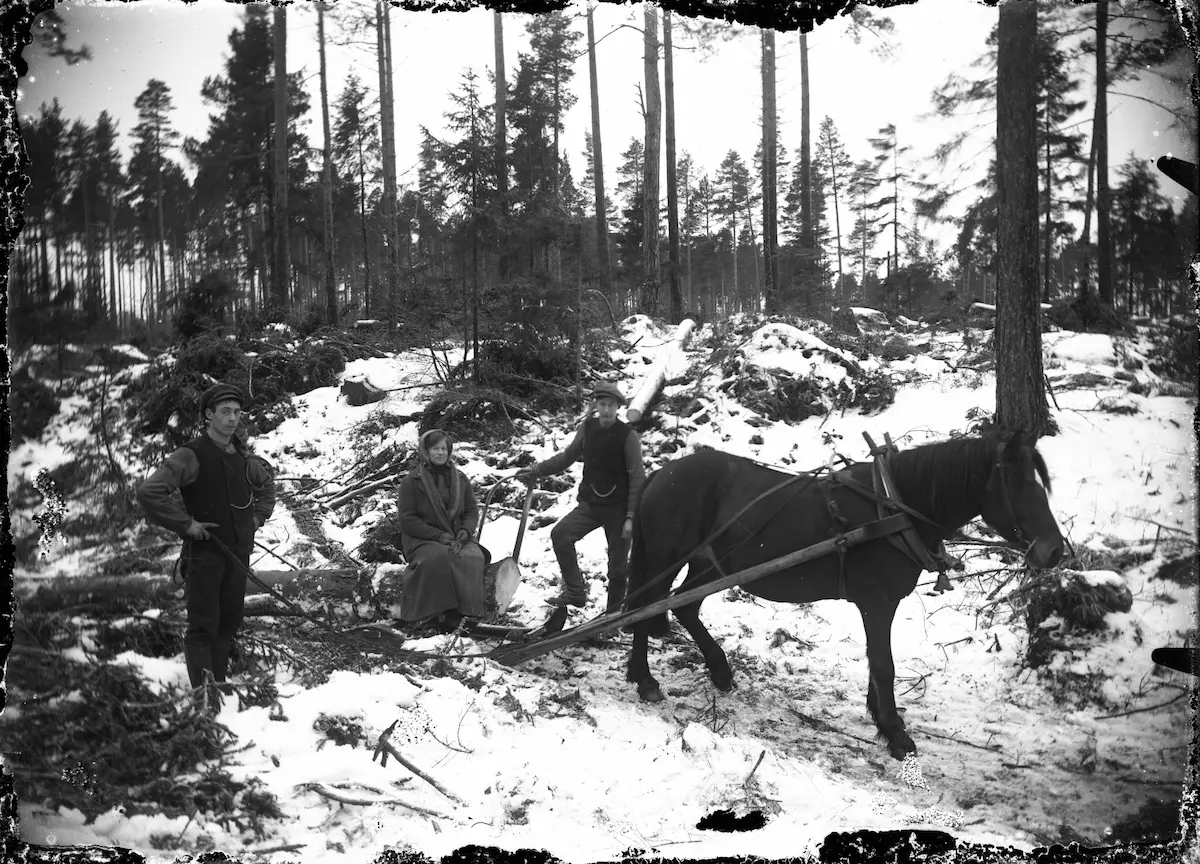
There is a photograph that captures an entire epoch: a horse with a sledge, loaded with freshly cut timber, on a narrow winter road through snowy forest. This was everyday life in Stora Kopparberg's forests as late as 1960. The horse was for a long time the engine of forestry.
The work of winters
Forest work followed the seasons with a precision that is hard for us to imagine today. Trees were felled during the winter half of the year, when the ground was frozen and the snow could bear the weight. The horses pulled the timber on sledges to the nearest watercourse or landing, where it was stored until the spring flood could carry it onward.
The relationship between the forest worker and the horse was close. The animal was not just a tool but a companion in the forest, a prerequisite for managing the heavy work. A good forest horse was worth its weight in gold.
The arrival of mechanisation
During the 1950s and 60s, forestry changed fundamentally. The chainsaw replaced the axe and the crosscut saw. Tractors and logging machines gradually took over the horse's role. The change was rapid and sweeping.
As late as 1960, the horse still played a central role in forest work. Barely a decade later, it had in practice disappeared from large-scale forestry. A very old tradition was wound down in a surprisingly short time.
A quiet revolution
The transition from horse to machine was one of the most sweeping changes in the history of Swedish forestry. It altered not only how the work was done but also the social life of the forest communities. The loggers' cabins emptied, the horse dealers vanished and an entire culture that had grown up around the horse in the forest became a memory.
But the photographs remain. And in them, we can still glimpse a time when the power that drove the Swedish forest industry had four legs and warm breath in the winter cold.