In the summer of 1687, the Falun copper mine sounded different. Deep inside the rock came rumbling noises the miners recognised. The mountain was moving. It had happened before, smaller collapses were a recurring part of mining life, but now the sound was different.
On 25 June, Midsummer's Day, it happened. Three of the mine's surface openings, Blankstöten, Bondestöten and Skeppsstöten, caved in together and formed a single enormous hole in the ground. The roar was heard miles away. Blocks of rock were thrown into the air. The next day, large parts of the Bockbacken area followed it down into the depths. Debris was later found at a depth of 350 metres inside the mine.
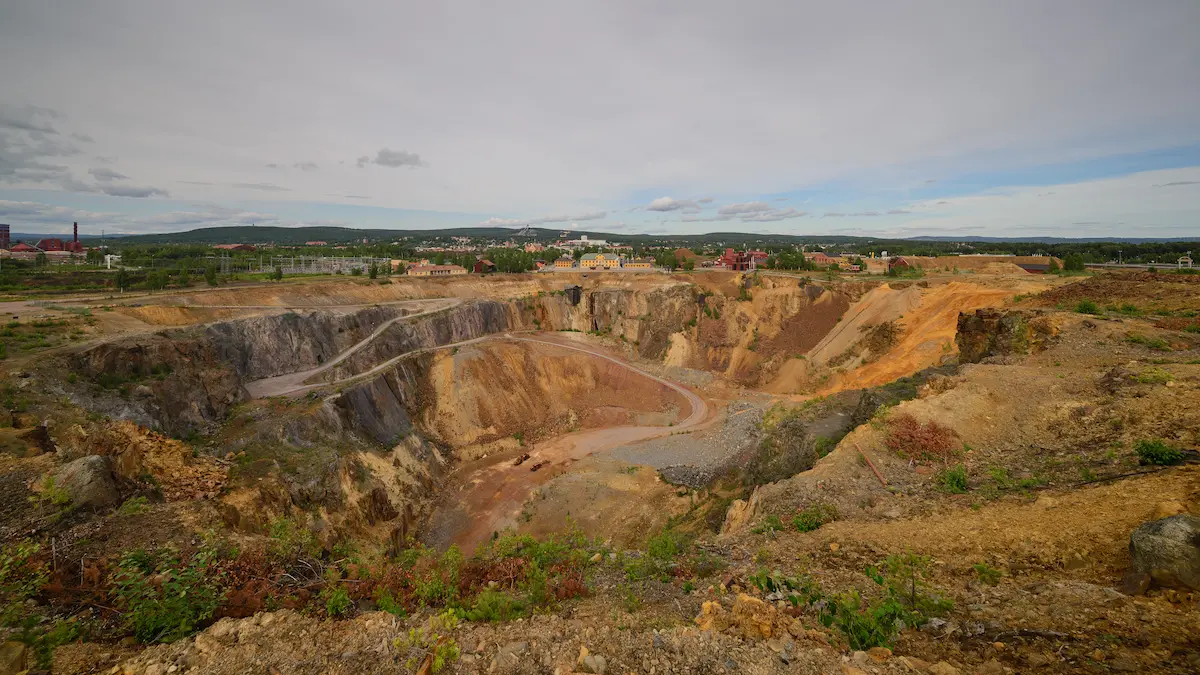
What emerged was Stora Stöten: an open pit with a circumference of 1.6 kilometres and a depth of nearly 100 metres.
A century of plunder behind a single moment
The collapse did not come out of nowhere. It was the end point of more than a century of intense and unplanned mining.
During the great-power era of the 1600s, the Falun copper mine was Sweden's single most important source of income. At times more than two thirds of Europe's total copper production came from here. The revenue funded the military, the administration and trade, and laid the foundation for Sweden as a European great power. The pressure on the mine was immense.
The miners blasted, hewed and drove galleries through the rock without any overall plan. The first map of the mine was not made until 1629, and although the survey marked a step towards better organisation, the operation remained shaped by greed and plunder. They took the copper where they found it, without sufficient regard for what held up the ground above. The three surface openings, Blankstöten, Bondestöten and Skeppsstöten, had grown ever larger. The walls between them thinned year by year.
The chance of midsummer
That the collapse did not take a single life is the most famous stroke of luck in Falun's history.
On an ordinary working day, hundreds of mine hands would have been down in the shafts. But the midsummer holiday was one of the great days off in the year.
The news spread quickly, not only because the collapse was enormous, but because no one had died. It was an event that told all of Sweden and parts of Europe that Falun had been struck by something that could, in a way, be called a miracle. The story of the great collapse where no one died was talked about far beyond the borders of Dalarna.
What Stora Stöten meant for the mine
The collapse was not the end of mining in Falun, copper extraction continued all the way to 1992, but it marked a turning point the mine never truly recovered from.
Copper production fell sharply after 1687. The peak had been reached in 1650, at around 3,000 tonnes. By the end of the 1710s, production had dropped to under 1,000 tonnes a year. The collapse meant that the most accessible and profitable parts of the deposit now lay beneath a chaos of fallen rock. Rebuilding the mine workings took years. And Sweden, whose great-power era rested heavily on the income from copper exports, did not have long left as a European great power.
The crater that changed a landscape
What appeared out of the collapse was not just a hole. It was a new landmark, a wound in the earth's crust that quickly came to define Falun as a place.
Carl Linnaeus visited Falun and looked down into Stora Stöten. Like many visitors over the course of the 1700s, he had an almost apocalyptic experience: the sulphur-smoking crater rim, the bare and scorched landscape around the mine, the roar from the smelting houses. Visitors from all over Europe came to see the place and carried away descriptions that compared Stöten to Vesuvius, purgatory or the underworld of antiquity.
For a long time the image of Falun was shaped by the contrast between the rich and the terrible: the unfathomable wealth of copper and the ruined landscape. Stora Stöten was the centre of that contrast.
Stöten today
Stora Stöten is today nearly 100 metres deep, with a circumference of 1.6 kilometres. The rock is silent but not dead. In the cracks and ledges along the crater walls nests the Eurasian eagle-owl, the provincial animal of Dalarna and one of the largest owl species in the world.
Since 2001 the site has been part of the UNESCO World Heritage Site of the Mining Area of the Great Copper Mountain, together with the mine, the surrounding industrial environment and the mining settlements around Falun.
A date with two answers
Sources on the collapse sometimes give different dates: 24 June, 25 June, even 5 July. All three are, in their own way, correct.
Falu Gruva's own pages give 25 June, but add that "around midsummer" the rock had begun to sound ominous. The difference comes down to the fact that Midsummer's Day historically always fell on 24 June, the feast of John the Baptist, and that the collapse may have happened late on Midsummer's Day or early the following day. The sources are not unambiguous.
A further layer is added by the fact that in 1687 Sweden used the Julian calendar, not the Gregorian one we use today. Sweden did not change calendars until 1753. Converted to our calendar, the date falls eleven days later, in early July.
None of this matters much to the story. What is certain is that it happened during the midsummer holiday of 1687, that the rock had given warning signs in the days before and that no one was underground when the great collapse came.