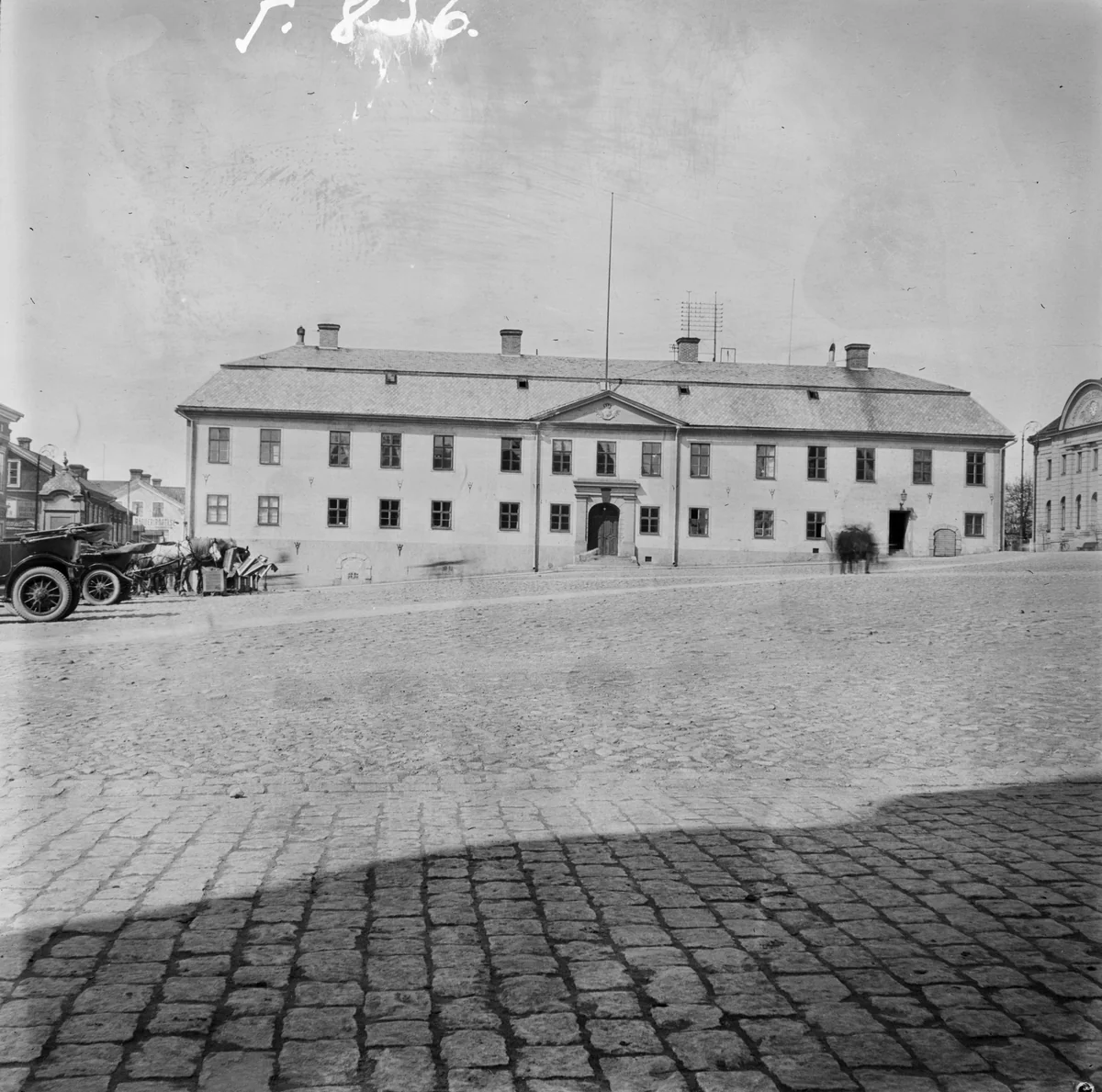
Falun's town hall looks like a tidy 18th-century building on the main square. It has always looked respectable. But behind the pale plaster lies a history full of witch trials, prison breaks, violent executioners and a town cellar where liquor sales were "unusually large". This is the story of a building that never quite became what it was meant to be and yet survived everything.
A grain warehouse that never became a grain warehouse
It all began with grain. In 1643, the burghers of Falun petitioned that a grain warehouse should be erected on the main square, a Crown-owned storehouse where the peasantry's tithe grain could be kept as a reserve in case of crop failure. The proposal was approved and walls soon began rising at the northern end of the square. Anchor irons shaped as crown marks were set into the foundation stones, to signal that this was state property.
But the city council changed its mind. A grain magazine was perhaps not what the town needed most. What it really lacked was a town hall. Through the county governor, Queen Christina was informed that the town now intended to build "a fine town hall of stone", though it had no money to do so. Might it possibly be allowed to use the foundation already laid for the grain warehouse?
The queen agreed. In April 1649 she granted Falun the plot, the stone walls and all the building material already purchased. She also donated copper from the Blankstöt mine over a three-year period. It was typical Christina: generous, but with the proviso that the townspeople were expected to "use the gift sparingly" and make the building a credit to the town.
52 women on the construction site
Master mason Hans Ersson led the work. Lime was bought from Rättvik, Järna and Älvdalen. The bricks, 106,000 of them, came from Johan Trotzig's brickworks at Rankhyttan and were shipped on small vessels across Lake Runn towards Falun. Since Tisken's water level was too low, the bricks had to be reloaded onto barges at Slussen.
By 1653 the building was largely finished. That year the site employed 23 male workers and 52(!) women. Wives, widows, daughters of burghers and maids worked side by side with the men, most likely as labourers. It was a single-storey building without ornament, and the furnishings were spartan to say the least. In the session chamber the table was draped in red cloth and the benches covered with boj, a coarse woollen fabric. Of the same material "as much as is needed for a canopy" was also procured. A map of the world was bought in 1658. That was all the luxury they could afford.
A staircase for shame and honour
In its present form the town hall is a two-storey building, but it took decades to get there. In 1667, county governor Gustaf Duwall openly complained that the town hall "after so many years appears unfinished, to the shame of both the governor and the town". That was a fairly sharp statement from a man who represented the Crown.
It helped. Work on an upper storey began in the 1670s, and in 1683 fortification captain Engelbrekt Otto was tasked with designing a staircase that was "both elegant and appropriate in proportion and bearing to the building itself". The staircase was built in wood. It lasted 150 years before becoming so rotten that in 1833 the decision was taken to switch to stone.
Only in 1749 was the extension considered fully complete, a hundred years after Queen Christina's gift. The inscription above the town hall's main entrance tells the whole tale in a single sentence: the building was founded through Christina's generosity and completed during the reign of King Fredrik, by the care of local officials.
Witches in the dungeon
From the very beginning the prison was housed in the town hall cellar. It was called "the kistan", the chest, and was meant for the town's needs, but came to serve as the county prison as well. The space was cramped and the guard was poor. Escapes happened regularly. In 1654 the kistan was reinforced because "the thieves had broken it apart".
It was in this damp cellar that the accused in the witch trials sat awaiting their sentences. Between 1668 and 1673 around 200 people were punished for alleged witchcraft and journeys to Blåkulla, most of them elderly women from Älvdalen and Mora. About fifty of them were beheaded and burned at the stake. The sentences were carried out in the accused's home parishes, but while waiting for trial and verdict they were locked up here in Falun, the parish prisons being considered insufficiently secure.
One of the women died in prison before the court of appeal's verdict had time to arrive. County governor Duwall had her body burned at the gallows site anyway, "in order, if possible, to move the hardened ones to some fear, repentance and confession".
The witch-hunt fever died out in Dalarna in 1673 but flared up again in 1757 in Ål parish. That time it ended differently. County governor von Hauswolff released the accused on his own authority, and the district judge who had ordered the torture was sentenced to flogging and damages.
Executioners who frightened the mayor
Falun hired its first executioner in 1649. The beheadings were carried out on the main square, right outside the town hall door. The gallows stood at first at Pilbo, but were considered too close to the mine and after a couple of years were moved to a forested rise near Främby. Things did not go well. The first executioner was of "such a temperament" that the magistrate had to admonish him not to do harm to the townspeople. A year later he was threatened with prison if he did not behave courteously towards people.
His successor was no better. He was brought before the court for having, together with the previous executioner's son, behaved threateningly towards the mayor, both with drawn swords. The court ruled that the sitting executioner had to flog his companion with a birch switch. Both were also admonished not to "walk around the courtyards and frighten people", or else Falun's worst prison awaited. Fifteen years later the flogged companion nonetheless retired as the official executioner.
The fires of 1761
In the summer of 1761, Falun was struck by two devastating fires that reduced about half of the town's buildings to ashes. The town hall, built of brick on a high foundation of hewn stone, did not burn down in the literal sense, but was severely damaged inside.
The reconstruction was a substantial project. The surveyor Erik Geisler drew up new plans and the master mason Daniel Lundqvist from Gävle led the work. It used 136,400 bricks, 52,100 roof tiles, 1,000 dozen boards and more than 10,000 days of labour. The total cost came to 155,727 daler in copper coin.
The inauguration was celebrated on 6 November 1766. The sources note laconically that the festivities went on "until eight o'clock the following morning".
The town cellar: Falun's thirstiest establishment
The rebuilt town hall housed a town cellar. In the 1780s, cellar master Lindman ran the establishment and opened a club room for pleasure-seeking townspeople. His successor Peter Gren announced that the conversation room was available "for honest company at 12 shillings a person, for which, alongside candle and firewood, tobacco and drink and supper are provided".
But the most memorable tavern keeper was A. W. Renström. A contemporary Falun alderman described him in his memoirs: "Nimble on his unusually short legs, the little ball-round man ran ceaselessly around his establishment, serving his customers without distinction of person, and for whom he always had a cheery if not witty jest. From morning until late evening his cellar rooms were filled to bursting with thirsty customers, and the consumption of spirits there was unusually large."
Renström started out poor and penniless but died in 1840 a wealthy man. The chronicler dryly notes that part of his fortune consisted of mine quarter-shares "of which many had come by the wet route out of various miners' keeping". The miners had, in other words, drunk away their mine shares.
The last tavern keeper in the town hall was Alexander Forssberg, a former actor who came to Falun in the 1850s. When the town hall was rebuilt he was forced to move to premises on the southern side of the main square.
Prisoners at the tavern
Having the prison and the town cellar in the same building produced situations one could scarcely make up. The guard was poor, and Karl-Gustaf Hildebrand has in his town history described how feebly things were arranged.
A woman sentenced to death socialised "in a less than decent manner" with prison guards, stable hands and officers' servants. A lieutenant who had killed a man and been sentenced to three months in prison received repeated visits from a woman from the Siljan region. The traffic grew so extensive that the county governor felt obliged to intervene. There was talk afterwards of fitting a lock to the lieutenant's cell, but it is unclear whether the plan was carried out. In the meantime the lieutenant managed to visit the town cellar, play billiards and be unpleasant to the regulars.
From courtroom to council office
The town hall's history after the 19th century is calmer, but the building kept changing roles. The premises have housed Kopparberg's private bank, Falu sparbank, the post office, the telegraph and telephone station and a residence for the mayor. The last mayor to live in the building was Erik Mauritz Sundell, who on his retirement in 1891 declined a pension but asked to be allowed to stay. He was, and there he died in 1896.
In 1931, a major renovation introduced central heating and new plaster. In 1964, the magistrate's court ceased to function in Falun, and the town hall's role as the seat of justice, more than 300 years long, was over. The municipal administration took over instead. During the 1960s renovation a surprising discovery was made: hidden under the overpaint in the old courtroom was a ceiling frieze in blue and grey, most likely painted by the decoration painter and alderman Nils Johan Asplind, who in the parish books was titled "court painter".
Today the town hall is still Falun's official representation venue. In the cellar vaults, the same vaults where the witches once sat imprisoned and thirsty customers crowded into Renström's tavern, sits the restaurant Rådhuskällaren. And above the main entrance still hangs the stone inscription that sums it all up: a town hall founded through a queen's generosity, finished a hundred years later, destroyed by fire, rebuilt and still in use almost four centuries after someone had the idea of building a grain warehouse.