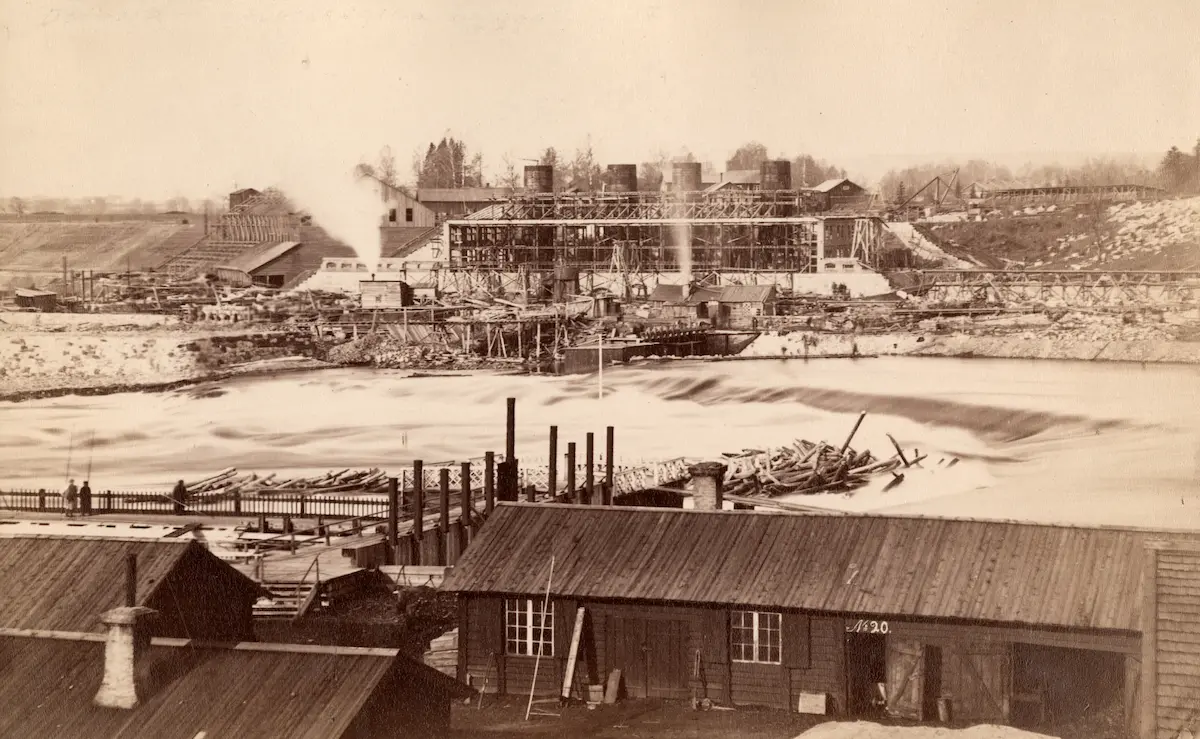
On the banks of the Dal River in Borlänge stands the Domnarvet ironworks, an industrial plant that for much of the 20th century was a central part of Stora Kopparberg's steel production. Here, merchant steel was manufactured and sold across the world.
From copper to iron
Stora Kopparberg's involvement in iron production was no coincidence. Bergslagen was permeated with iron ore and the metallurgical knowledge built up at the copper mine could be transferred to the steel industry. Domnarvet became the place where this knowledge was put into practice on a large scale.
The iron ore was brought from Grängesberg and other smaller mines in southern Dalarna. At Domnarvet it was refined into merchant steel that was shipped onto the world market. It was a complete industrial chain, from ore in the mountain to finished steel.
The years of expansion
In the years after the war and up towards 1960, demand for the company's products rose steadily. Prices were good and the period was marked by almost unbroken expansion. Domnarvet received extensive investment and was one of the main beneficiaries of the company's commitments.
But it was not only Stora Kopparberg's industries that grew. Industry expanded worldwide and by the mid-1960s competition on international markets intensified noticeably. Prices were squeezed, particularly for the bulk products that Domnarvet produced.
The steel crisis endgame
During the 1970s, the situation became untenable. Losses at both the speciality steelworks and the merchant steelworks at Domnarvet grew. Radical measures became unavoidable. In 1978, the semi-state-owned Svenskt Stål AB was formed and Stora Kopparberg transferred its merchant steel operations, including Domnarvet and the iron mines, to the new company.
It was the end of an era. But Domnarvet lives on in Borlänge and those who pass the old industrial buildings by the river can still sense the shadow of a time when steel was a major part of Stora Kopparberg.